
Corporate Escape Rooms: How Immersive Experiences Are Transforming HR, Organizational Culture, and T
digital overload;
cognitive fatigue;
burnout;
hyperconnectivity;
artificial intelligence;
hybrid work;
shrinking attention spans;
organizations are beginning to realize that high-performance teams are not simply made of busy people.
They are made of emotionally present people.
And this is exactly where immersive experiences such as corporate escape rooms are becoming strategically relevant.
What Is a Corporate Escape Room?
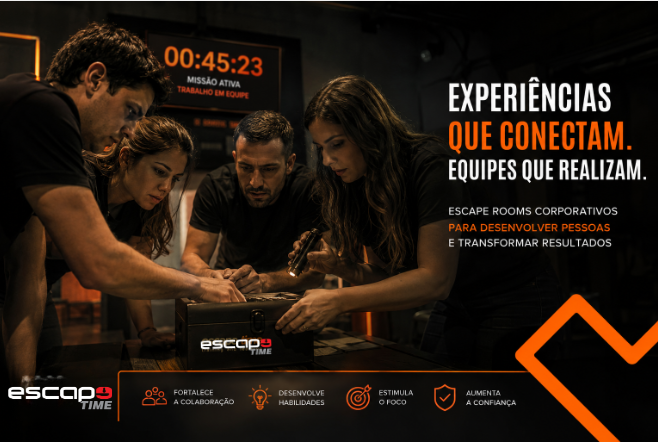
Corporate escape rooms are immersive, gamified experiences where teams must solve puzzles, collaborate under pressure, and make decisions together to complete a mission within a limited time.
But the best projects go far beyond “rooms with locks.”
They combine:
cinematic storytelling;
neuro-engagement;
gamification;
collaborative challenges;
technology;
sensory stimulation;
real-time decision-making.
In practice, they function as highly engaging behavioral simulators.
Why Are Companies Using Escape Rooms for Training and Team Integration?
Because experiences create far stronger emotional retention than presentations.
While traditional training often leads to passive information consumption, immersive experiences force people to:
live the learning process;
make decisions;
feel pressure;
solve conflicts;
collaborate naturally.
This activates:
emotional memory;
critical thinking;
team connection;
communication;
spontaneous leadership.
Modern companies have realized something important:
Soft skills are not developed only by listening.
They are developed by experiencing.
The Modern Workplace Problem: Overstimulation and Mental Disconnection
We live in the age of constant distraction.
Notifications, multitasking, endless meetings, and fragmented content consumption have dramatically reduced people’s ability to sustain deep focus.
Many professionals spend the entire day:
reacting;
switching tasks;
consuming fast stimuli;
without ever reaching a true state of concentration.
This directly impacts:
creativity;
problem-solving;
collaboration;
mental clarity;
decision quality.
Immersive experiences work precisely because they interrupt this pattern.
Inside an escape room:
smartphones lose importance;
the brain enters mission mode;
attention becomes contextual;
teams must cooperate to progress.
It becomes a pause that genuinely restores mental presence.
Escape Rooms and Neuroscience: Why Do They Work So Well?
Immersive experiences activate multiple cognitive systems simultaneously:
emotion;
memory;
logic;
spatial perception;
reward systems;
adrenaline;
collaborative problem-solving.
When strong storytelling, soundtracks, lighting, special effects, and dramatic progression are involved, the brain naturally increases:
dopamine;
engagement;
memory retention;
sense of belonging.
That is why gamified experiences generate much higher engagement rates than conventional training.
The Power of Immersive Storytelling
The most memorable experiences always tell powerful stories.
In the escape room universe, storytelling transforms participants into protagonists.
They stop “solving puzzles” and start:
saving humanity;
preventing an explosion;
finding a Templar treasure;
escaping a contaminated laboratory;
surviving psychological experiments.
This shift creates deep emotional immersion.
Examples of highly immersive narratives include:
Biological laboratories and survival
Players must stop the spread of a deadly virus while searching for the cure before it is too late.
Supernatural mysteries and investigations
Participants inherit a cursed hotel and must uncover occult secrets before the building is demolished.
Magical adventures
Teams become apprentices tasked with protecting the Philosopher’s Stone from dark forces.
High-tension missions
Players must stop a terrorist attack aboard the Orient Express before the train reaches its destination.
What Does an Escape Room Reveal About a Team?
Far more than any traditional team-building exercise.
During an immersive experience, it becomes possible to observe:
spontaneous leadership;
communication;
emotional intelligence;
decision-making;
behavior under pressure;
analytical thinking;
collaboration;
time management;
active listening;
adaptability.
And all of this happens organically.
Without feeling like an evaluation.
Escape Rooms as a Tool for HR and Organizational Culture
Innovative companies are already using escape rooms for:
onboarding;
team integration;
training;
conventions;
employer branding;
leadership development;
organizational culture;
corporate events;
behavioral assessment;
innovation programs.
Customized projects allow companies to incorporate:
corporate values;
cultural principles;
strategic challenges;
institutional messaging;
organizational goals.
In gamified corporate dynamics, each puzzle can represent a company principle or cultural value.
The Impact of AI on the Future of Corporate Experiences
As artificial intelligence advances, technical tasks will increasingly become automated.
This makes human skills even more valuable:
creativity;
collaboration;
empathy;
strategic thinking;
complex problem-solving.
Interestingly, all these competencies are naturally stimulated through immersive experiences.
The future of work will be hybrid:
highly technological;
deeply human.
Global Trends in Immersive Experiences
The international escape room market has evolved dramatically in recent years.
Key trends include:
cinematic environments;
electronic automation;
special effects;
projections;
augmented reality;
AI integration;
invisible sensors;
nonlinear storytelling;
multiple endings;
ultra-immersive experiences.
At the same time, corporate use of immersive experiences continues to grow as a tool for:
engagement;
culture;
experiential learning;
team building.
Why Do Experiences Create More Connection Than Presentations?
Because people remember what they feel far more than what they hear.
A presentation may inform.
An experience:
leaves a mark;
creates connection;
transforms;
builds emotional memory.
When a team experiences tension, cooperation, discovery, and victory together, something extremely powerful is created:
belonging.
The Real Competitive Advantage of Future Companies
The most competitive companies of the future will not simply be the most efficient.
They will be the ones capable of:
keeping people engaged;
reducing mental exhaustion;
creating strong culture;
stimulating real collaboration;
developing collective intelligence.
And perhaps the most important question for leaders today is:
Are we simply filling people’s schedules…
or are we creating experiences that truly restore energy, focus, and connection?
Because in the end:
sustainable productivity comes from teams that are able to think together.
And immersive experiences may be one of the most powerful ways to build that.