
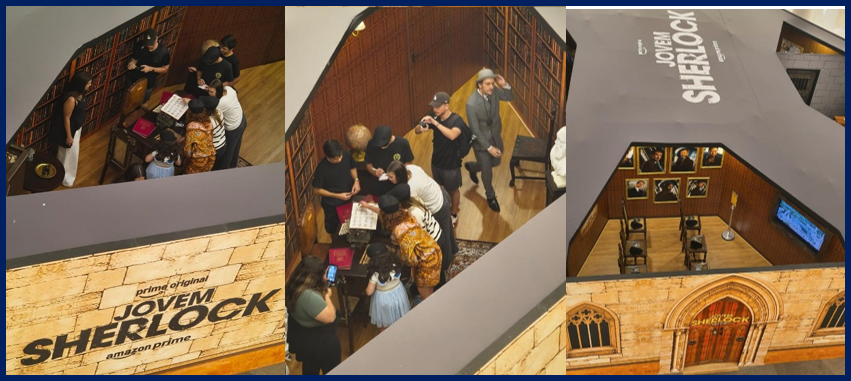
When the audience stops watching and starts living the story
The challenge: immersion in just a few minutes
Unlike traditional escape rooms, where players typically have around 60 minutes, this activation needed to operate in a highly dynamic format:
-
Approximately 20-minute experience
-
High audience turnover
-
Mostly first-time players
-
Continuous operation in an open environment
On top of that, it was essential to preserve the essence of Sherlock Holmes: observation, logic, and investigation.
The solution: narrative + scenography + gameplay
To achieve this, we designed an experience divided into 5 integrated environments:
-
Briefing
-
Library
-
Tunnel
Room
-
Police station
Each space was crafted to serve both a narrative purpose and to move players forward in their journey.
Storytelling as the foundation
From the very first interaction, participants were immersed in an investigative mission.
The goal wasn’t just to “solve puzzles,” but to think like Sherlock.
Smart and accessible puzzles
We designed challenges based on three key principles:
-
Intuitive (for beginners)
-
Fast-paced (aligned with the short format)
-
Rewarding (clear sense of progress)
Immersive scenography
The environments were built to fully transport players into the series’ universe, with furniture and props carefully aligned with the original production, enhancing the feeling of being inside the story.
Operations: the invisible challenge
Behind the scenes, a robust operation made everything possible:
-
12 people working simultaneously
-
Continuous flow management
-
Fast game reset between sessions
-
Consistent experience quality for every group
This type of activation requires not only creativity but also operational excellence — a factor often invisible, yet critical to success.
The result: real engagement
The impact was immediate:
-
High participation volume
-
Constant queues
-
Strong audience engagement
-
A memorable experience, even in a compact format
More than numbers, the key outcome was qualitative:
people weren’t just participating — they were living the story.
What we learned
This project reinforces a core belief at Escape Time:
Immersive experiences don’t depend solely on technology or time — but on how narrative, design, and operations connect.
When these three elements align, something powerful happens:
the audience stops being spectators and becomes protagonists.
The future of brand experiences
Activations like this point to a clear direction for the future of entertainment and marketing:
-
Less passivity
-
More interactivity
-
Less exposure
-
More experience
Because in the end, people don’t just remember what they saw —
they remember what they lived.